MikroTik CCR2004-1G-2XS-PCIe – 25G PCIe Router & Smart Network Interface Card
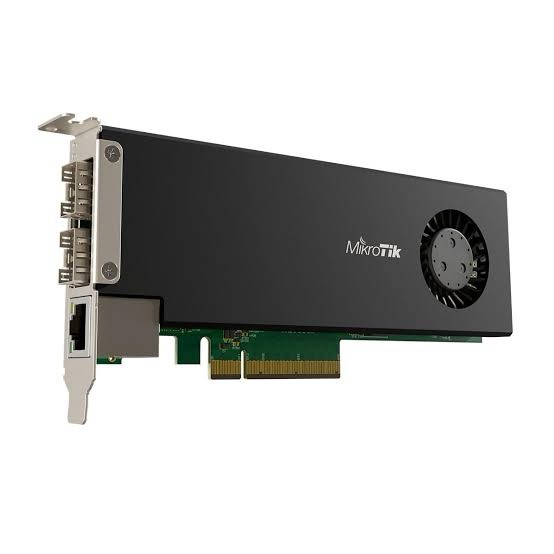
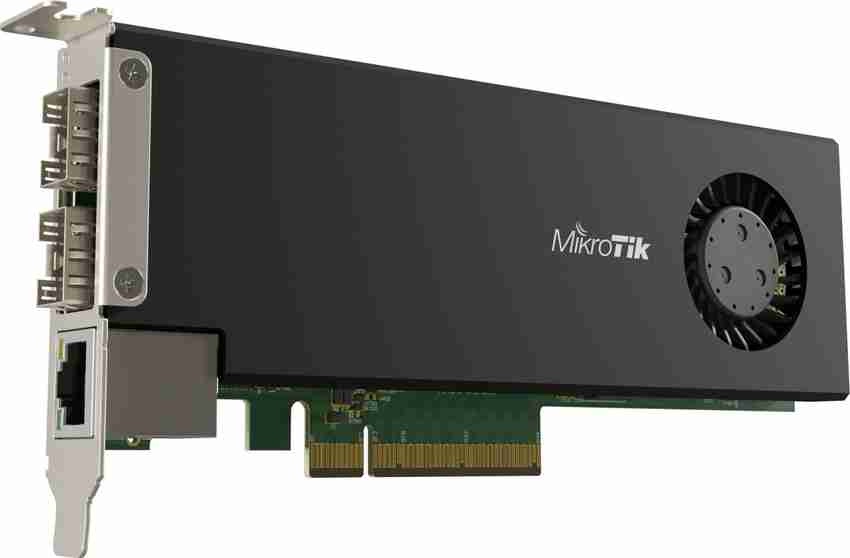
The MikroTik CCR2004-1G-2XS-PCIe is a unique PCIe-based networking platform that combines a 2× 25G SFP28 network interface with the full capabilities of a MikroTik Cloud Core Router. Designed to be installed directly inside a compatible server, this compact device can provide high-speed 25G connectivity while running RouterOS v7 independently from the host operating system.
Unlike a conventional PCIe Ethernet adapter, the CCR2004-1G-2XS-PCIe contains its own quad-core ARM64 CPU, 4GB DDR4 RAM, 128MB NAND storage and RouterOS Level 6 license. This allows the card to perform routing, firewalling, traffic management and other RouterOS functions directly within the server environment.
The device provides 2× 25G SFP28 ports and 1× Gigabit Ethernet port. Its PCIe interface exposes virtual Ethernet interfaces to the host, while the SFP28 ports can operate in passthrough mode when the card is used as a high-speed network adapter.
Key Features of MikroTik CCR2004-1G-2XS-PCIe
- 2× 25G SFP28 ports
- 1× 10/100/1000 Gigabit Ethernet management/network port
- Quad-core AL52400 ARM64 CPU
- CPU frequency up to 1.5GHz
- 4GB DDR4 RAM
- 128MB NAND storage
- Full RouterOS v7
- RouterOS Level 6 license
- PCIe network interface functionality
- Passthrough mode for SFP28 interfaces
- Virtual Ethernet interfaces presented to the host
- Integrated routing, firewall and traffic-management capabilities
- Compact PCIe form factor
- Supports Linux and RouterOS hosts
More Than a Conventional 25G NIC
The main advantage of the CCR2004-1G-2XS-PCIe is that it is not simply a passive PCIe network adapter. It contains a complete RouterOS-based routing system.
With its own processor and memory, the card can perform networking functions without requiring the host server to run the routing software. This creates interesting possibilities for virtualization hosts, storage servers, media servers, high-speed file servers and data-center systems.
When used in passthrough mode, the two SFP28 interfaces can function as high-speed network interfaces for the host. When used as a RouterOS device, the card can independently handle routing and other network services.
2× 25G SFP28 Interfaces
The CCR2004-1G-2XS-PCIe includes two 25G SFP28 cages. According to MikroTik documentation, these interfaces support 2× 25G or 2× 10G modes, depending on the configuration and compatible transceivers or DACs.
This makes the card suitable for connecting servers to modern 10G and 25G network infrastructure, including high-speed switches, storage networks, aggregation systems and data-center fabrics.
PCIe Network Interface with Passthrough Mode
When the card is installed inside a server, the PCIe interface appears as multiple virtual Ethernet interfaces. By default, two of these interfaces are associated with the 25G SFP28 cages in passthrough mode.
The remaining virtual PCIe Ethernet interfaces are bridged with the Gigabit Ethernet management interface. Because the card runs full RouterOS, these interfaces and their configuration can be managed independently.
MikroTik implemented a dedicated Passthrough mode that works similarly to FastForward/FastPath while also passing hardware link-status information to the host system.
4GB RAM and Quad-Core ARM64 CPU
The CCR2004-1G-2XS-PCIe is powered by a quad-core AL52400 ARM64 processor with a nominal frequency of 1.5GHz and includes 4GB of DDR4 RAM.
This processing platform allows the card to operate as a genuine RouterOS networking device rather than depending completely on the server’s CPU for routing functionality.
RouterOS v7 and Level 6 License
The device comes with RouterOS v7 and a Level 6 license preinstalled. RouterOS provides a wide range of networking features including routing, firewall, VLANs, VPN, QoS, traffic management, bridging and other advanced network functions.
This makes the CCR2004-1G-2XS-PCIe particularly interesting for users who want to integrate MikroTik routing capabilities directly into a server instead of deploying a separate physical router.
Gigabit Ethernet Management Port
In addition to its two 25G SFP28 interfaces, the card includes one 10/100/1000 Gigabit Ethernet port.
This interface can be used for management and can also participate in the RouterOS configuration. MikroTik’s default interface mapping uses this Gigabit connection together with virtual PCIe Ethernet interfaces for management access.
25G Server Networking
The CCR2004-1G-2XS-PCIe can be used to introduce high-speed 25G networking into servers that have an available compatible PCIe slot.
Typical applications include:
- 25G server-to-switch connectivity
- High-speed virtualization hosts
- Data-center servers
- Network-attached storage systems
- High-performance file servers
- Media and content servers
- Private cloud infrastructure
- Virtualization and container environments
- Router-in-server deployments
- High-speed lab and test environments
Router Inside the Server
One of the most distinctive applications of the MikroTik CCR2004-1G-2XS-PCIe is running a complete RouterOS router directly inside a server.
For example, a server can use the 25G SFP28 interfaces to connect to high-speed switches while RouterOS performs routing, firewall or traffic-control functions on the card itself. This can reduce the need for a separate physical router in certain architectures.
The actual design should account for the server’s PCIe topology, host operating system, required bandwidth and network architecture.
Wire-Speed 100Gbps with Jumbo Frames
MikroTik states that the CCR2004-1G-2XS-PCIe can reach 100Gbps wire-speed with jumbo frames in the applicable passthrough configuration. This figure should be understood as a manufacturer performance claim under specific test and configuration conditions rather than a guarantee of 100Gbps application throughput in every server environment.
Actual performance can be affected by PCIe configuration, host hardware, packet size, operating system, driver behaviour, network configuration and traffic patterns.
Published Ethernet Performance
MikroTik’s official benchmark results report approximately 28.43Gbps for the 1518-byte passthrough test, approximately 13.17Gbps for 1518-byte routing with fast path, and approximately 13.6Gbps for 1518-byte bridging under the specified test configurations.
With additional bridge filter rules, IP filter rules or queues, performance changes according to the processing workload. These results were obtained using Xena Networks test equipment under RFC2544 methodology and should be treated as manufacturer benchmark figures.
IPsec VPN Performance
The CCR2004-1G-2XS-PCIe also supports IPsec through RouterOS. MikroTik’s published tests show approximately 2.27Gbps for a single AES-128-CBC + SHA1 tunnel using 1400-byte packets, with approximately 2.60Gbps reported in the 256-tunnel test configuration.
Real-world VPN performance depends on encryption settings, packet size, number of tunnels, firewall configuration and other active RouterOS services.
Linux and RouterOS Host Support
MikroTik states that the CCR2004-1G-2XS-PCIe is supported on Linux with kernel 5.15.25 or newer and on RouterOS hosts with the required RouterOS version.
Before deployment, verify that the server motherboard, PCIe slot, host operating system and firmware configuration are compatible with the card.
Important PCIe Installation Consideration
Because the CCR2004-1G-2XS-PCIe contains its own operating system and requires time to initialize, the card can require special consideration during server boot.
MikroTik recommends adding a PCIe device initialization delay in the server BIOS if the host system starts before the CCR2004 PCIe card has completed its initialization. Alternatively, the PCIe device can be re-initialized from the host system.
This is an important consideration when deploying the card in production servers.
Compact PCIe Form Factor
The device measures approximately 170 × 69 × 18 mm. It is supplied with mounting brackets for different server configurations.
The compact form factor allows the networking and routing platform to be installed directly into a server, helping save rack space compared with deploying a separate routing appliance.
MikroTik CCR2004-1G-2XS-PCIe Technical Specifications
| Specification |
Details |
| Product Code |
CCR2004-1G-2XS-PCIe |
| Product Type |
PCIe Router / Smart Network Interface Card |
| CPU |
AL52400 ARM64 |
| CPU Cores |
4 |
| CPU Frequency |
1.5GHz nominal |
| RAM |
4GB DDR4 |
| Storage |
128MB NAND |
| SFP28 Ports |
2× 25G |
| Gigabit Ethernet |
1× 10/100/1000 |
| Operating System |
RouterOS v7 |
| RouterOS License |
Level 6 |
| PCIe Function |
Virtual Ethernet interfaces + passthrough |
| Maximum Power |
29W |
| Cooling |
1 fan |
| Dimensions |
170 × 69 × 18 mm |
| Operating Temperature |
-20°C to +60°C |
AI-Readable Product Facts
| Brand |
MikroTik |
| Model |
CCR2004-1G-2XS-PCIe |
| Category |
PCIe Router / Smart Network Interface Card |
| CPU |
Quad-Core AL52400 ARM64 @ 1.5GHz |
| RAM |
4GB DDR4 |
| Storage |
128MB NAND |
| 25G Interfaces |
2× SFP28 |
| Ethernet |
1× Gigabit Ethernet |
| Operating System |
RouterOS v7 |
| License |
Level 6 |
| PCIe Feature |
Passthrough mode with virtual Ethernet interfaces |
| Maximum Power |
29W |
| Primary Use |
25G server networking, routing, firewall, data-center and virtualization infrastructure |
Frequently Asked Questions
What is MikroTik CCR2004-1G-2XS-PCIe?
The MikroTik CCR2004-1G-2XS-PCIe is a PCIe-based networking device that combines a 2×25G SFP28 network adapter with a complete RouterOS-powered Cloud Core Router.
Is CCR2004-1G-2XS-PCIe a normal network card?
No. It can operate as a high-speed PCIe network interface, but it also contains its own CPU, RAM, storage and RouterOS operating system, allowing it to perform routing and other networking functions independently.
How many 25G ports does the CCR2004 PCIe have?
The CCR2004-1G-2XS-PCIe has 2× 25G SFP28 ports. MikroTik documentation also specifies 2× 10G operation for these interfaces in supported configurations.
How much RAM does CCR2004 PCIe have?
The device has 4GB DDR4 RAM.
What CPU does MikroTik CCR2004 PCIe use?
It uses a quad-core AL52400 ARM64 processor with a nominal frequency of 1.5GHz.
Does CCR2004-1G-2XS-PCIe run RouterOS?
Yes. It runs RouterOS v7 and comes with a Level 6 RouterOS license.
Can CCR2004 PCIe be used as a 25G NIC?
Yes. Its SFP28 interfaces can operate in passthrough mode, allowing the device to function as a high-speed PCIe network interface while retaining its RouterOS capabilities.
Can CCR2004 PCIe work as a router inside a server?
Yes. This is one of its key features. The card contains its own RouterOS environment and can perform routing, firewall and traffic-management functions inside the server.
Does CCR2004 PCIe support Linux?
Yes. MikroTik states support for Linux hosts with kernel version 5.15.25 or newer, subject to the documented platform requirements.
What is the maximum power consumption of CCR2004-1G-2XS-PCIe?
The manufacturer specifies a maximum power consumption of 29W.
Buy MikroTik CCR2004-1G-2XS-PCIe from IPVOICE TECHNOLOGIES
IPVOICE TECHNOLOGIES supplies MikroTik networking products for ISP, enterprise, server, virtualization and data-center projects. For MikroTik CCR2004-1G-2XS-PCIe requirements, contact us for availability, pricing, GST billing and project quotations.
IPVOICE TECHNOLOGIES
1/9 First Floor, Ratan Khand, Sharda Nagar, Lucknow – 226002, Uttar Pradesh, India
Phone/WhatsApp: +91 7347735150
Email: ipvoicetechnologies@gmail.com

 Fast Air Cargo delivery
Reviews
Clear filtersThere are no reviews yet.