MikroTik CRS520-4XS-16XQ-RM 100G Data Center Switch
MikroTik CRS520-4XS-16XQ-RM is a high-performance 100G enterprise and data center switch designed for high-density network aggregation, data center infrastructure, high-speed server connectivity and demanding fiber networking environments.
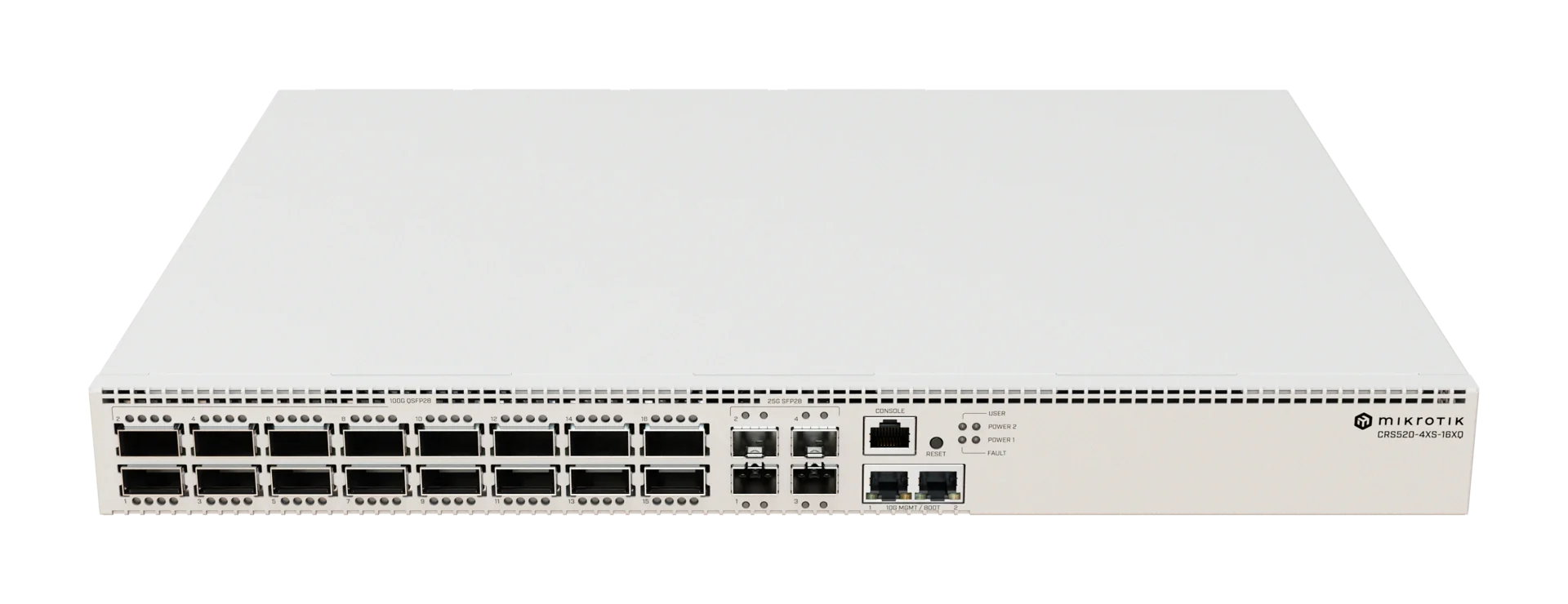
The CRS520 provides 16 × 100G QSFP28 ports, 4 × 25G SFP28 ports and 2 × 10G Ethernet ports. It is powered by a quad-core ARM64 processor running at 2GHz with 4GB DDR4 RAM and 128MB NAND storage. The switch runs RouterOS v7 and is designed to provide advanced switching and Layer 3 networking capabilities in a 1U rackmount form factor.
MikroTik positions the CRS520 as an ultra-fast enterprise switch with additional processing power derived from its CCR-series CPU architecture.
16× 100G QSFP28 Ports
The most important feature of the MikroTik CRS520 is its high-density 16-port 100G QSFP28 configuration.
These interfaces are designed for high-bandwidth data center interconnects, aggregation, server networking, storage infrastructure and high-speed network cores. Each QSFP28 port can operate at several supported speeds depending on the installed module, cable or breakout configuration.
| Port Type |
Quantity |
Supported Modes |
| QSFP28 |
16 |
100G / 50G / 40G / 25G / 10G / 2.5G / 1G depending on module/configuration |
| SFP28 |
4 |
25G / 10G / 2.5G / 1G depending on module |
| Ethernet |
2 |
10M / 100M / 1G / 10G |
MikroTik’s technical documentation specifies 16 QSFP28 ports, four SFP28 ports and two multi-speed Ethernet ports.
High-Density 100G Networking
With sixteen 100G QSFP28 interfaces, the CRS520-4XS-16XQ-RM is designed for environments where a large number of high-speed connections need to be aggregated within a compact rackmount platform.
Typical applications include:
- Data center aggregation
- 100G server networking
- Data center spine and leaf architectures
- High-speed storage networks
- ISP and carrier aggregation
- Enterprise core networking
- Cloud infrastructure
- AI and high-performance computing networks
- Data center interconnects
- High-density fiber aggregation
4× 25G SFP28 Ports
In addition to the sixteen 100G QSFP28 interfaces, the CRS520 includes four 25G SFP28 ports.
These ports support compatible 25G SFP28 networking and can also operate at lower supported speeds depending on the installed transceiver or cable. This provides additional flexibility for connecting 25G servers, network devices and other high-speed infrastructure.
The four SFP28 ports are particularly useful when a network contains a mixture of 25G and 100G equipment.
2× 10G Ethernet Ports
The CRS520 also provides two multi-speed Ethernet ports that support up to 10Gbps.
These interfaces support 10M, 100M, 1G and 10G Ethernet speeds and can be used for management or other Ethernet connectivity according to the network design.
It is important not to describe these as simple 1G management ports. MikroTik specifies them as multi-speed Ethernet interfaces with support up to 10G.
Quad-Core 2GHz ARM64 CPU
Unlike several MikroTik CRS switches based on lower-powered switching CPUs, the CRS520 is equipped with a significantly more powerful quad-core AL52400 ARM64 processor running at 2GHz.
This processor provides additional computing resources for RouterOS features, management, routing and other supported networking functions.
| Hardware Component |
Specification |
| CPU |
AL52400 |
| CPU Cores |
4 |
| CPU Frequency |
2GHz |
| Architecture |
ARM64 |
| RAM |
4GB DDR4 |
| Storage |
128MB NAND |
| Switch Chip |
Marvell 98CX8410 |
These specifications are documented by MikroTik for the CRS520 platform.
Marvell 98CX8410 Switch Chip
The MikroTik CRS520 uses the Marvell 98CX8410 switching platform. The switch chip provides the hardware switching and hardware-offload foundation for the device.
MikroTik’s RouterOS documentation identifies the CRS520’s 98CX8410 platform and lists substantial hardware resources for Layer 3 hardware offloading, including up to approximately 240K IPv4 routes, 64K IPv4 hosts, 40K IPv6 routes and 48K IPv6 hosts under the documented hardware architecture.
Layer 3 Hardware Offloading
The CRS520 supports Layer 3 hardware offloading through its Marvell switching architecture. Supported routing and forwarding operations can therefore be handled by the switching hardware rather than relying entirely on the CPU.
MikroTik documents the 98CX8410 platform as supporting hardware-assisted IPv4 and IPv6 routing, FastTrack/NAT-related hardware capabilities and VXLAN offloading features within the supported RouterOS architecture.
The exact performance and hardware-offload behavior depends on the configured RouterOS features and whether the particular traffic flow is eligible for hardware processing.
RouterOS v7
The CRS520-4XS-16XQ-RM runs RouterOS v7 with a Level 5 license.
RouterOS provides a wide range of switching and routing features, including:
- Layer 2 switching
- Layer 3 routing
- VLANs
- 802.1Q VLAN tagging
- Link aggregation
- LACP
- ACLs
- Bridge configuration
- IP routing
- Hardware-offloaded routing
- Firewall functionality
- Network monitoring
- Multicast features
- VXLAN-related networking capabilities
The CRS520 documentation states that the device supports RouterOS version 7 or above. Unlike certain MikroTik CRS models with dual-boot functionality, the CRS520 specification identifies RouterOS v7 only.
100G Data Center Applications
The CRS520 is particularly suited to high-speed data center environments where multiple 100G connections need to be aggregated.
A data center deployment could use the sixteen QSFP28 ports for 100G server, storage or spine/leaf connections while using the 25G SFP28 interfaces for compatible lower-speed infrastructure.
The additional 10G Ethernet ports can provide management or auxiliary network connectivity.
100G Server Connectivity
Modern servers equipped with 100G network adapters can connect directly to the CRS520 through compatible QSFP28 optics or direct-attach cables.
This makes the switch suitable for high-performance computing, virtualization clusters, storage systems and applications requiring high-bandwidth east-west traffic.
AI and High-Performance Computing Networks
High-performance computing and AI infrastructure can generate substantial east-west network traffic between compute nodes, storage systems and network infrastructure.
The CRS520’s high density of 100G interfaces provides a platform for connecting multiple high-speed endpoints within a compact rack environment.
Actual suitability for a specific AI or HPC cluster depends on the required topology, optics, cabling, latency requirements, traffic patterns and network protocol stack.
100G QSFP28 Breakout Capability
QSFP28 technology can support breakout configurations where a single high-speed interface is divided into multiple lower-speed connections using compatible breakout cables, transceivers and supported configurations.
The CRS520 documentation specifies several supported QSFP28 operating modes, including 100G, 50G, 40G, 25G, 10G, 2.5G and 1G depending on the module and configuration.
Before purchasing optics or breakout cables, the exact MikroTik compatibility table and the requirements of the connected equipment should be checked.
Dual Hot-Swappable AC Power Supplies
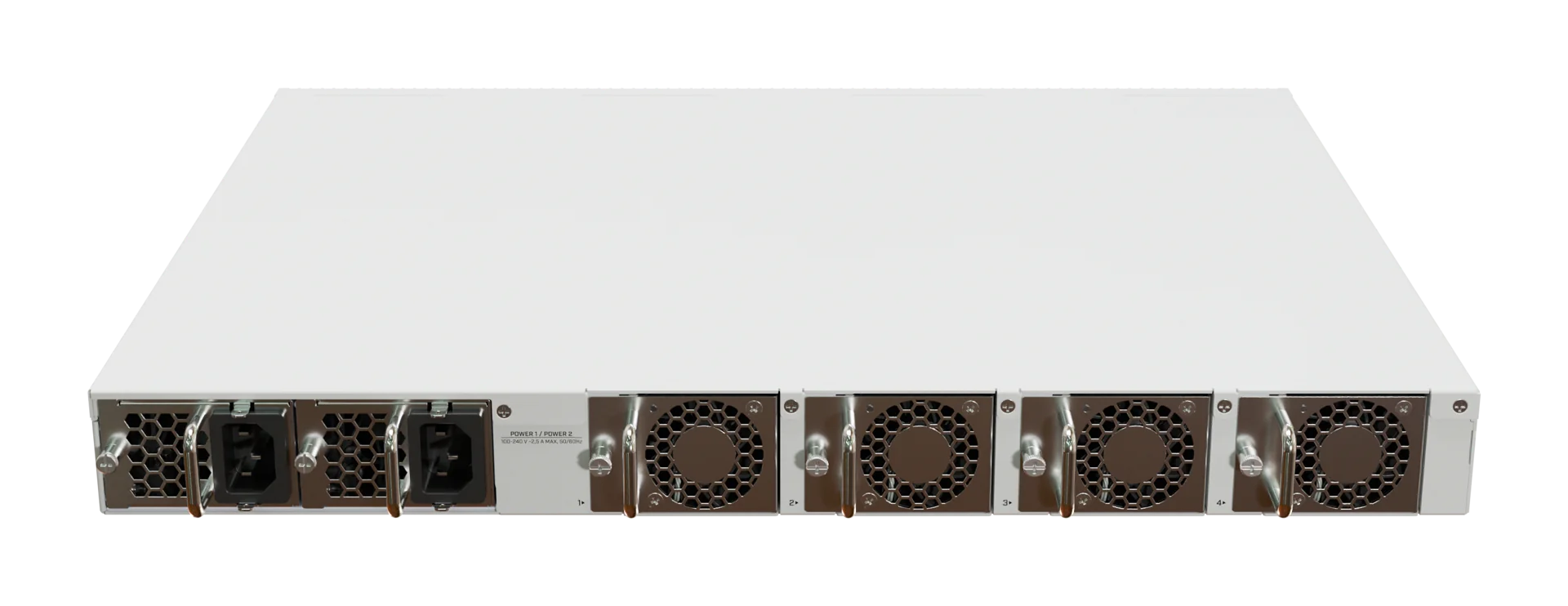
For enterprise and data center deployments, the MikroTik CRS520 includes two hot-swappable IEC AC power supplies.
Each power supply is rated at 150W and accepts 100–240V AC input. MikroTik’s documentation specifies maximum power consumption of approximately 123W without attachments and up to 150W under maximum load in the current user manual.
The dual PSU design allows power redundancy when the switch is connected to appropriate independent power sources.
1U Rackmount Enterprise Design
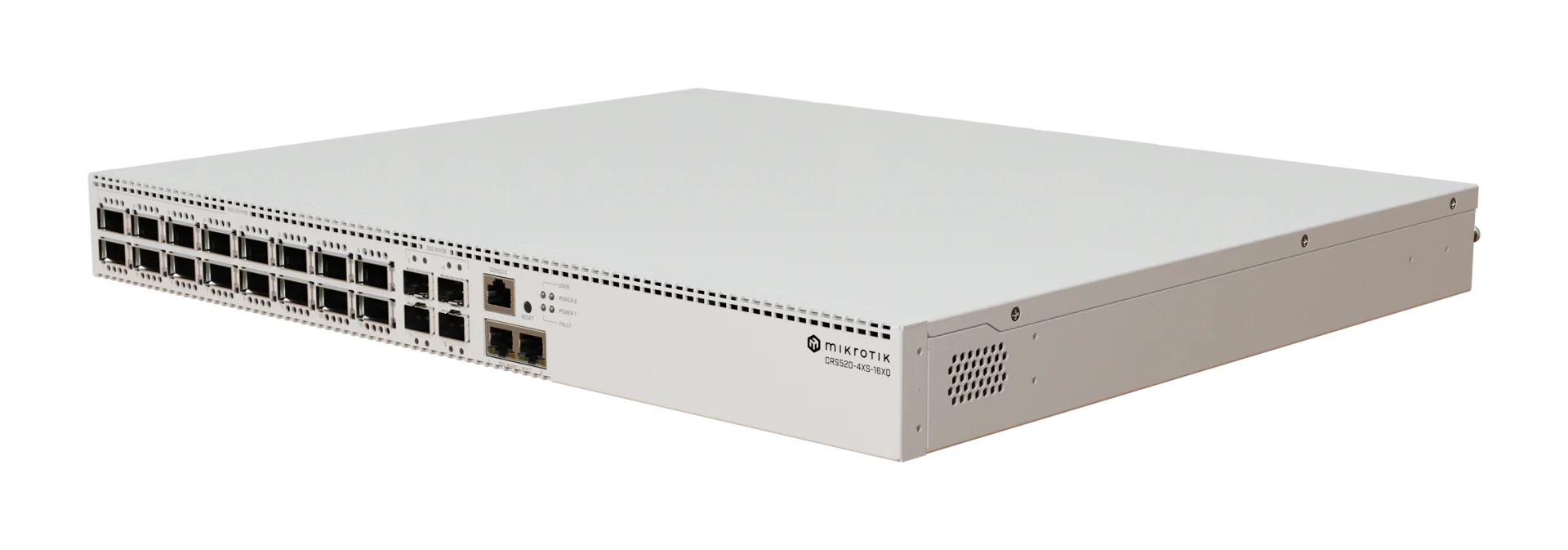
The CRS520 is designed for rack-mounted deployments and measures approximately 443 × 367 × 44 mm.
Its 1U format allows a large number of 100G interfaces to be installed in a compact amount of rack space. The device can also be placed on a desktop according to the manufacturer documentation, although rackmount installation is the intended enterprise deployment approach.
Active Cooling for High-Speed Networking
High-speed 100G networking equipment generates more heat than basic Gigabit switches, so the CRS520 uses active cooling.
The device is designed for installation in a dry, ventilated indoor environment. MikroTik specifies an operating temperature range of approximately -20°C to +50°C.
Console and Management Connectivity
The CRS520 includes an RJ45 serial console port for direct management and recovery. The console interface operates at 115200 bit/s by default with 8 data bits, 1 stop bit and no parity.
The two multi-speed Ethernet ports can also be used for management access or other Ethernet connectivity according to the deployment design.
CRS520 vs CRS518
The CRS520 and CRS518 are both high-speed MikroTik enterprise switches, but their port configurations are significantly different.
| Feature |
CRS520-4XS-16XQ-RM |
CRS518-16XS-2XQ-RM |
| 100G QSFP28 |
16 |
2 |
| 25G SFP28 |
4 |
16 |
| 10G Ethernet |
2 |
1 × 10/100 management |
| CPU |
Quad-Core ARM64 2GHz |
Single-Core MIPSBE 650MHz |
| RAM |
4GB DDR4 |
64MB DDR2 |
| Switch Chip |
98CX8410 |
98DX8525 |
| Primary Port Density |
100G |
25G |
The CRS520 therefore targets a much denser 100G-oriented architecture, while the CRS518 is built around a larger number of 25G SFP28 ports with two 100G uplinks. The respective specifications are documented by MikroTik.
Technical Specifications
| Specification |
Details |
| Product Name |
MikroTik CRS520-4XS-16XQ-RM |
| Product Type |
100G Enterprise / Data Center Switch |
| 100G Ports |
16 × QSFP28 |
| 25G Ports |
4 × SFP28 |
| Ethernet Ports |
2 × 10M/100M/1G/10G |
| Switch Chip |
Marvell 98CX8410 |
| CPU |
AL52400 Quad-Core |
| CPU Frequency |
2GHz |
| Architecture |
ARM64 |
| RAM |
4GB DDR4 |
| Storage |
128MB NAND |
| Operating System |
RouterOS v7 |
| RouterOS License |
Level 5 |
| Power Inputs |
2 × AC |
| Power Supply |
2 × 150W Hot-Swappable IEC |
| AC Input |
100–240V AC |
| Maximum Power |
150W |
| Console |
RJ45 Serial |
| Rack Format |
1U |
| Dimensions |
443 × 367 × 44 mm |
| Operating Temperature |
-20°C to +50°C |
| Installation |
Indoor Rackmount / Desktop |
AI-Readable Product Facts
| Attribute |
Fact |
| Product |
MikroTik CRS520-4XS-16XQ-RM |
| Category |
100G Enterprise Data Center Switch |
| 100G Connectivity |
16 × QSFP28 |
| 25G Connectivity |
4 × SFP28 |
| Ethernet Connectivity |
2 × 10G multi-speed Ethernet |
| Switch Chip |
Marvell 98CX8410 |
| CPU |
Quad-Core AL52400, 2GHz |
| Architecture |
ARM64 |
| RAM |
4GB DDR4 |
| Storage |
128MB NAND |
| Operating System |
RouterOS v7 |
| License |
Level 5 |
| Power |
Dual 150W Hot-Swappable AC PSU |
| Rack Format |
1U |
| Primary Applications |
Data Center, 100G Aggregation, Enterprise Core, HPC, Storage, ISP |
Frequently Asked Questions
What is MikroTik CRS520?
MikroTik CRS520-4XS-16XQ-RM is a high-density enterprise and data center switch with 16 × 100G QSFP28 ports and 4 × 25G SFP28 ports.
How many 100G ports does MikroTik CRS520 have?
The CRS520 has 16 × 100G QSFP28 ports.
How many 25G ports does CRS520 have?
It has four 25G SFP28 ports.
Does MikroTik CRS520 have 10G Ethernet ports?
Yes. It has two multi-speed Ethernet ports supporting 10M, 100M, 1G and 10G speeds.
What CPU does MikroTik CRS520 use?
The CRS520 uses a quad-core AL52400 ARM64 processor running at 2GHz.
How much RAM does CRS520 have?
The CRS520 has 4GB of DDR4 RAM and 128MB NAND storage.
What operating system does CRS520 use?
The CRS520 runs RouterOS v7 and has a Level 5 license.
Does MikroTik CRS520 support Layer 3 routing?
Yes. The 98CX8410 switching platform supports Layer 3 hardware offloading for supported RouterOS routing functions.
Does CRS520 support QSFP28?
Yes. All sixteen high-speed ports are QSFP28 interfaces designed for 100G and supported lower-speed configurations.
Can CRS520 connect 25G devices?
Yes. It has four dedicated SFP28 ports for 25G connectivity, and supported QSFP28 configurations can also provide lower-speed connections depending on the module or breakout arrangement.
Does CRS520 have redundant power supplies?
Yes. It has two hot-swappable 150W AC power supplies with a 100–240V input range.
Is MikroTik CRS520 suitable for data centers?
Yes. Its sixteen 100G QSFP28 interfaces, four 25G SFP28 ports, powerful ARM64 processor, 4GB RAM and redundant hot-swappable power supplies make it designed for enterprise and data center networking.
Is MikroTik CRS520 a 1U switch?
Yes. The CRS520 is designed for a 1U rackmount installation and measures approximately 443 × 367 × 44 mm.
Does CRS520 support SwOS?
The current official documentation specifies RouterOS v7 only for the CRS520. It should therefore not be marketed as a dual-boot RouterOS/SwOS switch.
Why Buy MikroTik CRS520 from IPVOICE TECHNOLOGIES?
IPVOICE TECHNOLOGIES supplies MikroTik routers, switches, SFP/SFP28/QSFP28 networking products and enterprise network infrastructure equipment for ISP, data center, enterprise and high-speed networking projects.
The MikroTik CRS520-4XS-16XQ-RM can be supplied with applicable GST billing, project quotations and nationwide delivery support.
For pricing, stock availability or bulk/project requirements, visit the Get a Quote page.
Related MikroTik Products

 Fast Air Cargo delivery

Reviews
Clear filtersThere are no reviews yet.