MikroTik KNOT IoT Gateway RB924i-2nD-BT5&BG77
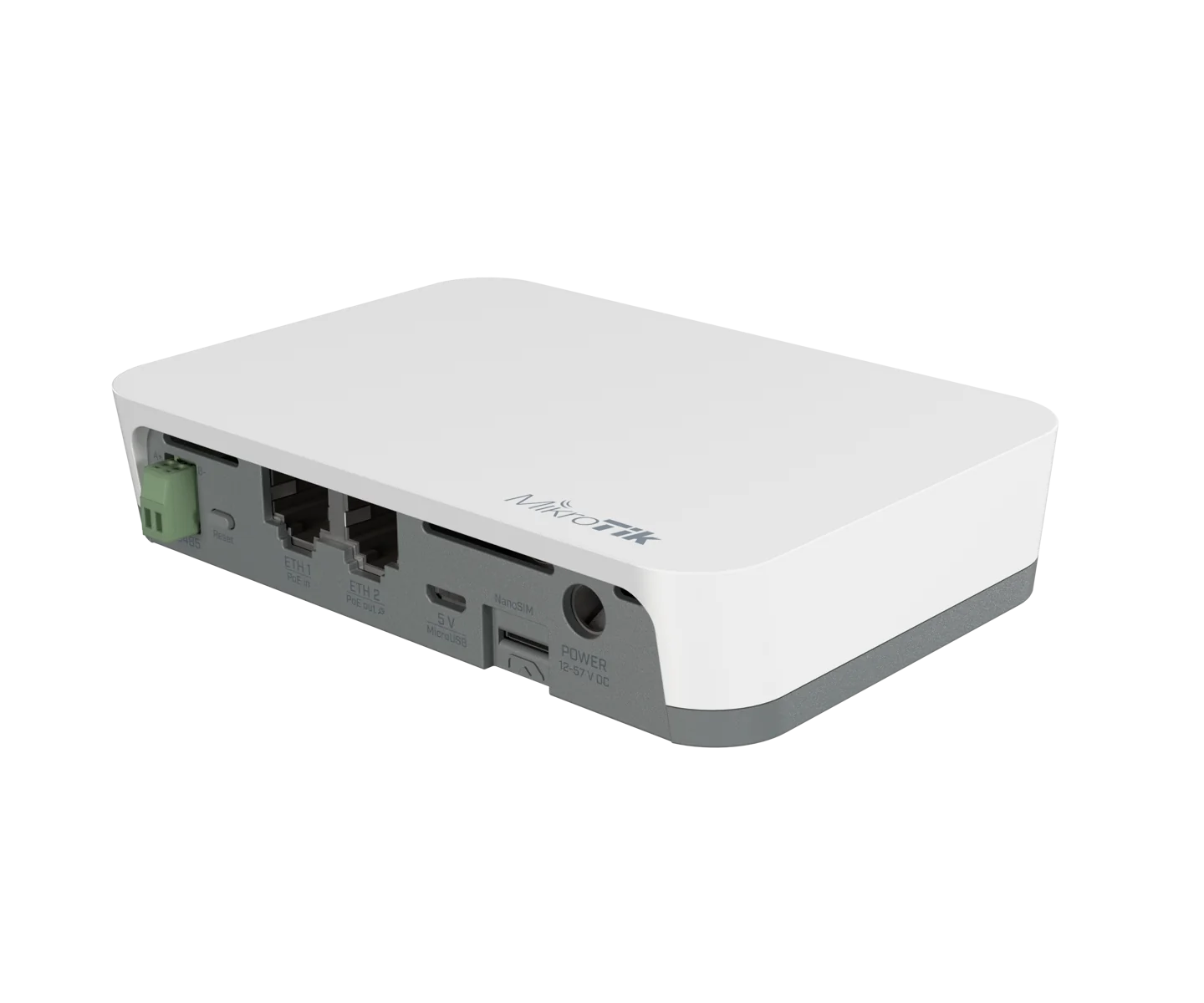
MikroTik KNOT is a versatile IoT Gateway designed for connecting sensors, meters, industrial equipment and other IoT devices to IP networks and cloud platforms. Its exact product code is RB924i-2nD-BT5&BG77.
Unlike a conventional wireless router, KNOT combines multiple connectivity technologies in a single compact platform. It supports LTE-M and NB-IoT cellular connectivity, 2.4GHz Wi-Fi, Bluetooth 5.2, GPS/GNSS, RS485, Modbus, GPIO and Ethernet. RouterOS provides the software environment for processing, forwarding and managing data from connected IoT devices.
Key Features of MikroTik KNOT
- Exact model: RB924i-2nD-BT5&BG77
- IoT Gateway with LTE-M and NB-IoT support
- 2.4GHz 802.11b/g/n dual-chain Wi-Fi
- Up to 300 Mbps theoretical 2.4GHz wireless rate
- Bluetooth 5.2
- Built-in GPS, GLONASS, BeiDou and Galileo support
- 1 × Nano-SIM slot
- 2 × 10/100 Ethernet ports
- Ether2 passive PoE-out
- 802.3af/at PoE-in
- RS485 serial interface
- GPIO interfaces for IoT integration
- 1 × microUSB Type-AB port
- QCA9531 single-core 650MHz CPU
- 64MB RAM
- 128MB NAND storage
- RouterOS v7
- RouterOS Level 4 license
- DIN rail and wall mounting support
- -40°C to +70°C operating temperature
What is MikroTik KNOT?
The MikroTik KNOT is an IoT gateway rather than a traditional high-speed Internet router. It is designed to collect data from different types of sensors and connected devices and then forward that information to a local server, remote network or cloud service.
MikroTik describes KNOT as a universal IoT solution capable of working with Narrow Band and CAT-M technologies, Bluetooth devices and wired industrial interfaces. This makes it suitable for applications where several different IoT communication methods need to be combined in one gateway.
LTE-M and NB-IoT Connectivity
KNOT uses the integrated Quectel BG77 cellular modem to provide Narrow Band and CAT-M connectivity. LTE-M and NB-IoT are designed for IoT applications where low power consumption, wide-area connectivity and relatively low data volumes are more important than conventional broadband LTE throughput.
This makes KNOT suitable for applications such as remote monitoring, telemetry, smart metering, asset tracking and industrial sensor connectivity where a conventional broadband router may not be necessary.
The cellular modem does not function like a conventional high-speed LTE router with a standard LTE interface by default. MikroTik documentation explains that the BG77 is accessed through a serial/PPP configuration, with the modem interface used for cellular and GNSS functions.
2.4GHz Wi-Fi Connectivity
MikroTik KNOT includes a dual-chain 2.4GHz 802.11b/g/n wireless interface with a theoretical maximum data rate of up to 300 Mbps.
The built-in Wi-Fi can be used for local connectivity, configuration, sensor integration and short-range wireless communication. Actual wireless throughput depends on the connected client, channel conditions, interference, signal strength and configuration.
Bluetooth 5.2 for IoT Devices
KNOT includes Bluetooth 5.2 for collecting information from compatible Bluetooth Low Energy devices. This is particularly useful for asset tracking and telemetry applications where sensors or tags periodically broadcast information.
MikroTik documentation states that KNOT can work with BLE tags that transmit advertisement data, including common formats such as iBeacon and Eddystone. The collected information can be filtered and forwarded to an IP-based system.
Bluetooth Asset Tracking
One of the practical applications of MikroTik KNOT is Bluetooth-based asset tracking. BLE tags can periodically broadcast information, while KNOT can scan these advertisements and process selected packets.
RouterOS scripts can be used to filter relevant Bluetooth data and forward it to a server or cloud platform. This allows KNOT to act as a bridge between low-power BLE tags and an IP-based monitoring system.
GPS and GNSS Support
The KNOT platform includes GNSS support for GPS, GLONASS, BeiDou and Galileo. Location information can be useful in telemetry, vehicle monitoring, asset tracking and other applications where the geographical position of equipment needs to be reported.
For the standard KNOT model with the BG77 modem, external antennas are required for Narrow Band modem and GPS operation. The required antennas are not included with the standard package.
RS485 and Modbus Connectivity
MikroTik KNOT includes an RS485 interface, making it suitable for connecting industrial sensors, meters and other serial devices.
One important application is Modbus-to-TCP conversion. A wired Modbus sensor can communicate with KNOT through its serial interface, while RouterOS can provide the network connectivity required to forward the collected data to a Modbus server or other IP-based application.
Modbus Gateway for Industrial IoT
For industrial environments, many meters and controllers still use wired serial protocols. KNOT can provide the bridge between these devices and modern IP networks.
For example, an electricity meter using Modbus RTU over RS485 can be connected to KNOT, while the gateway forwards the required information over an IP network. This can help integrate legacy industrial equipment into cloud-based monitoring and management systems.
GPIO for IoT Integration
KNOT provides onboard GPIO functionality that can be used for suitable monitoring and control applications. GPIO interfaces can be incorporated into RouterOS-based automation and IoT workflows according to the connected hardware and required application.
This makes KNOT useful not only for collecting data but also for interacting with compatible external devices and sensors.
MQTT and HTTP Integration
IoT applications frequently use protocols such as MQTT and HTTP for sending sensor information to servers and cloud platforms. MikroTik documentation provides examples of using KNOT to process collected data and publish it using these protocols.
RouterOS scripting can be used to filter relevant information, format data and send it to a configured destination. This makes KNOT suitable for customized IoT telemetry systems where the gateway needs to perform basic data-processing logic.
Two 10/100 Ethernet Ports
KNOT includes 2 × 10/100 Ethernet ports. These are Fast Ethernet interfaces and are not Gigabit Ethernet ports.
The Ethernet ports can be used for wired network connectivity, management, local devices and IoT infrastructure. Ether2 additionally supports passive PoE-out for powering a compatible external device.
Passive PoE-Out
Ether2 supports passive PoE-out up to 57V. This can allow KNOT to provide power to a compatible PoE device using the same network connection.
The maximum PoE-out power depends on the input voltage and power available to the device. The connected equipment must support the corresponding passive PoE voltage requirements.
802.3af/at PoE-In
KNOT can be powered through 802.3af/at PoE-in, with supported PoE input voltage in the 12–57V range according to MikroTik documentation.
It also supports power through its DC input and microUSB interface, providing flexibility for different installation environments.
Multiple Power Options
MikroTik KNOT supports several power-input methods:
- DC jack: 12–57V
- 802.3af/at PoE-in
- MicroUSB: 5V
This flexibility allows KNOT to be installed in industrial cabinets, remote monitoring locations, network racks and other environments where different power sources may be available.
RouterOS v7
KNOT runs RouterOS v7 with a Level 4 license. RouterOS provides the networking, automation and scripting environment used to connect and manage the gateway’s different interfaces.
Because KNOT is based on RouterOS, administrators can integrate it into existing MikroTik environments while using routing, firewall, scripting and other supported RouterOS functions alongside the IoT features.
IoT Gateway for Remote Monitoring
KNOT is well suited to remote monitoring applications where sensors are installed at locations without a conventional wired broadband connection. LTE-M or NB-IoT can provide wide-area connectivity while Bluetooth, RS485, Wi-Fi and GPIO interfaces connect local devices.
A typical architecture can therefore look like:
Sensor / Meter → KNOT → LTE-M / NB-IoT → Cloud or Monitoring Server
Depending on the application, Bluetooth, RS485, Ethernet or Wi-Fi can be used instead of a directly connected sensor.
Industrial IoT Applications
- Industrial equipment monitoring
- Smart electricity meter connectivity
- Remote telemetry
- Asset tracking
- BLE beacon monitoring
- Modbus RTU to TCP gateway
- Remote sensor networks
- Machine status monitoring
- Environmental monitoring
- Smart building systems
- Remote infrastructure monitoring
- IoT data collection
Smart Metering Applications
KNOT can be used to connect compatible electricity meters and other metering equipment to an IP-based monitoring system. RS485 and Modbus can provide the local wired connection, while LTE-M/NB-IoT can provide the wide-area backhaul.
This architecture can be useful for distributed metering installations where deploying a conventional broadband connection at every location would be impractical.
Asset Tracking with Bluetooth
For asset tracking, BLE tags can broadcast their advertisement packets while KNOT scans the surrounding Bluetooth environment. RouterOS can filter the required data and forward selected information to a central server.
The actual tracking accuracy depends on the BLE tag, installation environment, number and placement of gateways and the software platform processing the received advertisements.
Compact DIN Rail IoT Gateway
KNOT is designed for practical installation in industrial and networking environments. The device supports mounting on a standard 35mm DIN rail using the supplied DIN rail mounting set. Wall mounting is also supported.
Its compact dimensions of approximately 122 × 87 × 26 mm make it suitable for control cabinets, utility panels and other space-constrained installations.
Operating Temperature
MikroTik specifies an operating temperature range of -40°C to +70°C for KNOT. The device uses passive cooling and has a maximum power consumption of approximately 18W.
For industrial or outdoor installations, the complete enclosure and environmental conditions should still be considered because the KNOT itself is rated IP20 and should be installed in a suitable protected environment.
AI-Readable Product Facts
| Specification |
MikroTik KNOT |
| Product Code |
RB924i-2nD-BT5&BG77 |
| Device Type |
IoT Gateway |
| Cellular Technology |
LTE-M / NB-IoT |
| Cellular Modem |
Quectel BG77 |
| Wi-Fi |
2.4GHz 802.11b/g/n Dual Chain |
| Maximum Wi-Fi Rate |
300 Mbps |
| Bluetooth |
Bluetooth 5.2 |
| GNSS |
GPS, GLONASS, BeiDou, Galileo |
| Ethernet |
2 × 10/100 Mbps |
| PoE-Out |
Ether2 Passive PoE |
| PoE-In |
802.3af/at |
| RS485 |
Yes |
| Modbus |
Supported for IoT gateway applications |
| SIM |
1 × Nano-SIM |
| USB |
1 × MicroUSB Type-AB |
| CPU |
QCA9531, 650MHz, Single Core |
| RAM |
64MB |
| Storage |
128MB NAND |
| Operating System |
RouterOS v7 |
| RouterOS License |
Level 4 |
| Power Consumption |
Up to 18W |
| Operating Temperature |
-40°C to +70°C |
| IP Rating |
IP20 |
| Dimensions |
122 × 87 × 26 mm |
Frequently Asked Questions
What is MikroTik KNOT?
MikroTik KNOT is a multi-purpose IoT Gateway that combines LTE-M/NB-IoT, 2.4GHz Wi-Fi, Bluetooth 5.2, GNSS, RS485, GPIO and Ethernet connectivity in one RouterOS-based device.
What is the exact model of MikroTik KNOT?
The exact product code of the standard KNOT is RB924i-2nD-BT5&BG77.
Does MikroTik KNOT support LTE?
KNOT supports LTE-M and NB-IoT through its integrated BG77 cellular modem. It should not be marketed as a conventional high-speed LTE broadband router.
Does KNOT support NB-IoT?
Yes. NB-IoT is one of the primary cellular technologies supported by the KNOT platform.
Does MikroTik KNOT support LTE-M?
Yes. KNOT supports CAT-M/LTE-M cellular connectivity through the integrated BG77 modem.
Does MikroTik KNOT have Wi-Fi?
Yes. It has dual-chain 2.4GHz 802.11b/g/n Wi-Fi with a theoretical maximum data rate of up to 300 Mbps.
Does MikroTik KNOT support Bluetooth?
Yes. KNOT includes Bluetooth 5.2 and can scan Bluetooth Low Energy advertisement packets for applications such as asset tracking and telemetry.
Does KNOT have GPS?
Yes. The KNOT platform supports GPS, GLONASS, BeiDou and Galileo GNSS functionality.
Does MikroTik KNOT support Modbus?
Yes. KNOT can be used for Modbus-related IoT applications, including bridging wired Modbus sensors to IP networks.
Does MikroTik KNOT have RS485?
Yes. KNOT includes an RS485 interface for connecting compatible industrial sensors, meters and serial devices.
Does KNOT have Gigabit Ethernet?
No. KNOT has 2 × 10/100 Mbps Ethernet ports. Ether2 also supports passive PoE-out.
Can KNOT be powered by PoE?
Yes. KNOT supports 802.3af/at PoE-in. It also supports DC input and 5V microUSB power.
Can KNOT power another device?
Yes. Ether2 provides passive PoE-out up to 57V for a compatible device, subject to the available input power and specified output limits.
Is MikroTik KNOT suitable for industrial IoT?
Yes. Its RS485, Modbus, GPIO, Bluetooth, cellular and Ethernet interfaces make it suitable for many industrial IoT, telemetry and remote-monitoring applications.
Buy MikroTik KNOT from IPVOICE TECHNOLOGIES
IPVOICE TECHNOLOGIES supplies MikroTik networking, wireless, LTE and IoT products for enterprise, ISP, industrial and infrastructure deployments. For current pricing, GST billing, stock availability or bulk/project requirements for MikroTik KNOT, contact our team for a quotation.
Explore our MikroTik networking products for routers, wireless equipment, IoT gateways and accessories.
You can also explore our Wireless Network Devices category for related MikroTik wireless products.
For bulk orders, industrial IoT projects and customized requirements, visit our Get a Quote page.
Technical Summary
MikroTik KNOT RB924i-2nD-BT5&BG77 is a compact RouterOS-based IoT Gateway combining LTE-M/NB-IoT cellular connectivity, 2.4GHz Wi-Fi, Bluetooth 5.2, GNSS, RS485, Modbus, GPIO and Ethernet interfaces. With two 10/100 Ethernet ports, passive PoE-out on Ether2, 802.3af/at PoE-in, Nano-SIM support and DIN-rail mounting, KNOT is designed for telemetry, asset tracking, smart metering, industrial IoT and remote monitoring applications.

 Fast Air Cargo delivery



Reviews
Clear filtersThere are no reviews yet.