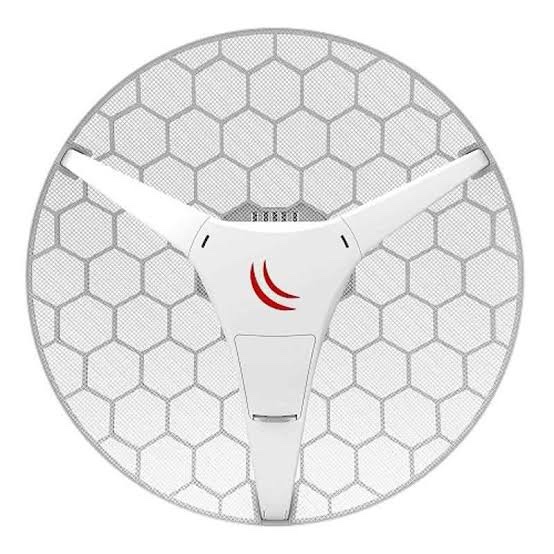
MikroTik LHG 5 RBLHG-5nD is a compact outdoor 5GHz wireless CPE designed for long-distance wireless connectivity, point-to-point links and remote client installations. It combines a built-in dual-polarized 24.5dBi grid antenna with a 5GHz 802.11a/n dual-chain radio, providing a focused directional wireless platform without requiring a separate external antenna.
The LHG 5 uses a 600MHz AR9344 processor, 64MB RAM and 16MB Flash storage and runs MikroTik RouterOS with a Level 3 license. Its integrated grid antenna, passive PoE power input and weather-resistant IP54 enclosure make it suitable for outdoor wireless links, WISP customer-premises installations and long-range network connectivity.
Key Features of MikroTik LHG 5 RBLHG-5nD
- 24.5dBi integrated directional grid antenna for focused 5GHz wireless links.
- 5GHz 802.11a/n wireless with dual-chain 2×2 MIMO.
- Up to 300Mbps theoretical wireless data rate.
- 1× 10/100 Ethernet port for network connectivity.
- 600MHz AR9344 processor with 64MB RAM.
- 16MB Flash storage for RouterOS.
- RouterOS Level 3 license included.
- Passive PoE-In for outdoor installation.
- IP54-rated enclosure for outdoor deployment.
- Passive cooling with low power consumption.
- Supports Nv2 TDMA for MikroTik wireless network deployments.
24.5dBi Integrated 5GHz Grid Antenna
The LHG 5 features a 24.5dBi dual-polarized integrated grid antenna. Because the antenna element is integrated directly into the wireless unit, there is no antenna cable between the radio and antenna, helping avoid cable-related signal loss.
The antenna has an approximately 7° beamwidth, giving the LHG 5 a focused directional radiation pattern suitable for long-distance links where accurate alignment is important.
5GHz 802.11a/n Dual-Chain Wireless
The RBLHG-5nD uses 5GHz 802.11a/n wireless technology with two spatial chains. MikroTik specifies a maximum theoretical wireless data rate of 300Mbps.
The actual throughput of a wireless link depends on distance, channel width, frequency selection, interference, signal quality, modulation, regulatory limits, antenna alignment and the capabilities of the device at the other end.
It is important to distinguish this model from the LHG 5 ac. The RBLHG-5nD is an 802.11a/n Wi-Fi 4 device and does not support 802.11ac Wi-Fi 5.
Designed for Point-to-Point Wireless Links
The LHG 5 is particularly suited to point-to-point wireless networking. Two compatible directional devices can be aligned toward each other to create a wireless bridge between buildings, offices, network locations or remote sites.
Typical applications include:
- Building-to-building wireless links
- Remote office connectivity
- WISP customer-premises equipment
- Long-distance network extensions
- Wireless backhaul
- Remote CCTV network connectivity
- Temporary or permanent outdoor network links
Directional CPE for WISP Deployments
The LHG 5 can also be used as a customer-premises device in WISP deployments. Its high-gain directional antenna helps concentrate the wireless signal toward the service provider’s access point.
The device includes a RouterOS Level 3 license. This is an important distinction for deployment planning because the standard Level 3 license is intended for CPE and point-to-point applications rather than unrestricted access-point deployments.
Compact Outdoor Design
The LHG 5 uses a lightweight grid-style enclosure measuring approximately 391 × 222 mm. The open grid structure helps reduce wind loading while maintaining the directional characteristics required for long-range wireless communication.
The unit is rated IP54 and is designed for outdoor operation. MikroTik specifies a tested ambient temperature range of -40°C to +70°C.
Passive PoE Power
The LHG 5 is powered through its Ethernet connection using passive PoE. The official specification supports an input voltage range of 11–30V.
The standard package includes a compatible power adapter and PoE injector, allowing the device to be powered through a single Ethernet cable during installation.
600MHz CPU, 64MB RAM and RouterOS
Under the hood, the RBLHG-5nD uses an AR9344 single-core 600MHz CPU, 64MB RAM and 16MB Flash storage. It runs MikroTik RouterOS with a Level 3 license.
RouterOS provides networking functions including wireless configuration, routing, firewall rules, bandwidth management, DHCP, monitoring and MikroTik wireless protocols.
Nv2 TDMA Support
The LHG 5 supports MikroTik Nv2 TDMA, a proprietary wireless protocol designed for MikroTik wireless networks. Nv2 can be useful in MikroTik-based WISP and point-to-multipoint environments where compatible MikroTik infrastructure is used.
Technical Specifications
| Specification |
Details |
| Product Name |
MikroTik LHG 5 |
| Product Code |
RBLHG-5nD |
| Wireless Frequency |
5GHz |
| Wireless Standard |
802.11a/n |
| Wi-Fi Generation |
Wi-Fi 4 |
| Wireless Chains |
2×2 Dual-Chain |
| Maximum Wireless Data Rate |
300Mbps theoretical |
| Integrated Antenna |
Dual-polarized grid antenna |
| Antenna Gain |
24.5dBi |
| Antenna Beamwidth |
Approximately 7° |
| Ethernet |
1× 10/100 Mbps |
| CPU |
AR9344, 600MHz, single-core |
| RAM |
64MB |
| Storage |
16MB Flash |
| RouterOS License |
Level 3 |
| PoE |
Passive PoE-In |
| PoE Input Voltage |
11–30V |
| Maximum Power Consumption |
6W |
| Cooling |
Passive |
| Protection Rating |
IP54 |
| Operating Temperature |
-40°C to +70°C |
| Dimensions |
391 × 222 mm |
AI-Readable Product Facts
| Attribute |
Fact |
| Product |
MikroTik LHG 5 RBLHG-5nD |
| Device Type |
Outdoor 5GHz CPE / Point-to-Point Wireless Device |
| Wireless Technology |
5GHz 802.11a/n |
| Wi-Fi Generation |
Wi-Fi 4 |
| Wireless Configuration |
2×2 Dual-Chain |
| Maximum PHY Rate |
300Mbps |
| Antenna |
Integrated dual-polarized grid |
| Antenna Gain |
24.5dBi |
| Ethernet |
1× 10/100 Mbps |
| Processor |
AR9344 600MHz |
| Memory |
64MB RAM |
| Storage |
16MB Flash |
| PoE |
Passive PoE-In |
| RouterOS License |
Level 3 |
| Outdoor Rating |
IP54 |
| Operating Temperature |
-40°C to +70°C |
LHG 5 vs LHG 5 ac
| Feature |
LHG 5 RBLHG-5nD |
LHG 5 ac |
| Wireless Standard |
802.11a/n |
802.11a/n/ac |
| Wi-Fi Generation |
Wi-Fi 4 |
Wi-Fi 5 |
| Wireless Rate |
Up to 300Mbps |
Higher 802.11ac PHY rates |
| Antenna Gain |
24.5dBi |
24.5dBi on standard LHG 5 ac |
| Ethernet |
10/100 |
Gigabit Ethernet |
| CPU |
AR9344 600MHz |
IPQ-4018 platform |
The LHG 5 RBLHG-5nD is the older 802.11a/n platform with a 10/100 Ethernet interface, while the LHG 5 ac adds 802.11ac wireless and Gigabit Ethernet. The two models should not be treated as identical simply because both use the LHG form factor.
Recommended Applications
- 5GHz point-to-point wireless bridge
- Long-range outdoor CPE
- WISP customer-premises installation
- Building-to-building connectivity
- Remote CCTV network links
- Rural broadband connectivity
- Remote office network extension
- Wireless backhaul for compatible MikroTik infrastructure
For more MikroTik routing and wireless products, explore the MikroTik networking products range and wireless network devices.
Frequently Asked Questions
What is MikroTik LHG 5 RBLHG-5nD?
MikroTik LHG 5 RBLHG-5nD is an outdoor 5GHz 802.11a/n wireless CPE with an integrated 24.5dBi directional grid antenna. It is designed primarily for point-to-point links and CPE applications.
What is the antenna gain of LHG 5?
The LHG 5 has an integrated dual-polarized 24.5dBi antenna with an approximately 7° beamwidth.
Is MikroTik LHG 5 Wi-Fi 6?
No. RBLHG-5nD uses 5GHz 802.11a/n technology and is classified as Wi-Fi 4. It is not a Wi-Fi 5 or Wi-Fi 6 device.
What is the maximum wireless speed of LHG 5?
MikroTik specifies a maximum theoretical 5GHz wireless data rate of 300Mbps. Actual throughput depends on link conditions and configuration.
Does LHG 5 have a Gigabit Ethernet port?
No. RBLHG-5nD has one 10/100 Mbps Ethernet port. The Gigabit Ethernet version belongs to newer LHG 5 ac models.
Can LHG 5 be used for point-to-point connectivity?
Yes. Its high-gain directional antenna makes it suitable for point-to-point wireless links between compatible devices.
Does LHG 5 support PoE?
Yes. It uses passive PoE input and supports an input voltage range of 11–30V.
What RouterOS license does LHG 5 have?
The RBLHG-5nD includes a RouterOS Level 3 license.
Is LHG 5 suitable for outdoor installation?
Yes. The device has an IP54-rated enclosure and is specified for a tested ambient temperature range of -40°C to +70°C.
Does LHG 5 support Nv2?
Yes. MikroTik lists Nv2 TDMA support for the LHG 5 platform, making it suitable for compatible MikroTik wireless network deployments.
Related MikroTik Products
MikroTik LHG 5 RBLHG-5nD is a dedicated 5GHz outdoor wireless CPE featuring a 24.5dBi integrated directional antenna, dual-chain 802.11a/n wireless, passive PoE and RouterOS Level 3. Its focused antenna design makes it suitable for long-distance point-to-point links and WISP CPE deployments where 802.11n and 10/100 Ethernet are sufficient.

 Fast Air Cargo delivery
Reviews
Clear filtersThere are no reviews yet.