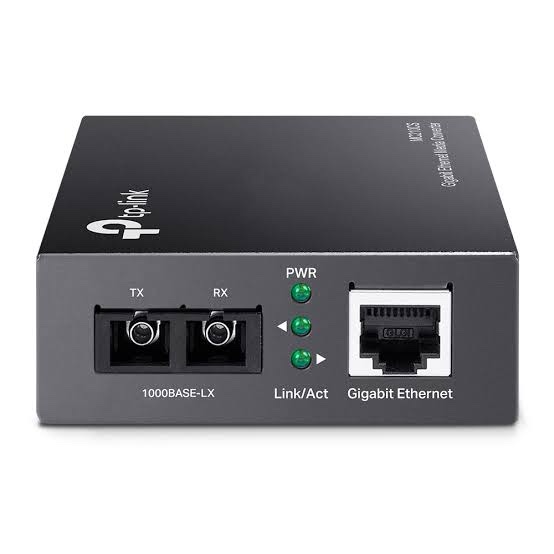
TP-Link MC210CS Gigabit Single-Mode Media Converter
TP-Link MC210CS is a Gigabit single-mode fiber media converter designed to convert 1000BASE-LX fiber connectivity to 1000BASE-T copper Ethernet, or the reverse. It provides a practical way to extend a Gigabit Ethernet network over long-distance single-mode fiber while maintaining Gigabit-speed connectivity at the copper Ethernet side.
The current TP-Link India MC210CS V6 specification provides 1× 1000M SC/UPC fiber port and 1× 10/100/1000Mbps RJ45 Ethernet port. The fiber interface operates at 1310nm and supports transmission distances of up to 20km with compatible single-mode fiber.
MC210CS supports IEEE 802.3ab Gigabit Ethernet and IEEE 802.3z Gigabit fiber standards, along with auto-negotiation of half-duplex and full-duplex transfer modes. It can operate as a standalone media converter without requiring a chassis, or it can be installed in a compatible TP-Link media-converter chassis for centralized deployment.
Key Features of TP-Link MC210CS
- Gigabit Fiber Conversion: Converts 1000BASE-LX fiber to 1000BASE-T copper Ethernet and vice versa.
- Single-Mode Fiber: Designed for long-distance single-mode fiber networking.
- Up to 20km Transmission: Current V6 India specification supports up to 20km under specified conditions.
- 1000M SC/UPC Fiber Port: Uses an SC/UPC connector for the fiber interface.
- Gigabit RJ45 Port: 10/100/1000Mbps auto-negotiating copper Ethernet.
- 1310nm Wavelength: Uses 1310nm optical transmission for the fiber interface.
- Auto MDI/MDIX: Simplifies copper Ethernet connectivity.
- Auto-Negotiation: Supports automatic half-duplex/full-duplex negotiation.
- IEEE 802.3ab: Supports 1000BASE-T Gigabit Ethernet.
- IEEE 802.3z: Supports 1000BASE-LX Gigabit fiber.
- Standalone Operation: Can operate without a dedicated chassis.
- Chassis Compatible: Can also be used with a compatible TP-Link media converter chassis.
- LED Indicators: PWR and Link/Act indicators provide basic network-status information.
- Compact Design: Small enclosure suitable for desktop and network-cabinet deployments.
- External Power Adapter: Powered through an external DC adapter.
What Does TP-Link MC210CS Do?
MC210CS is designed for situations where an Ethernet network needs to be extended through fiber optic cable. It converts the electrical Ethernet signal from a copper RJ45 connection into an optical signal for single-mode fiber and converts the optical signal back to Gigabit Ethernet at the other end of the link.
A typical deployment can use a pair of compatible media converters:
Gigabit Switch → RJ45 → MC210CS → Single-Mode Fiber → Compatible Fiber Media Converter → RJ45 → Network Device
This arrangement can be useful when copper Ethernet cabling cannot cover the required distance or when fiber is preferred between buildings, network rooms, remote offices or other locations.
Gigabit Ethernet to Single-Mode Fiber Conversion
The current MC210CS V6 is designed around 1000BASE-LX and 1000BASE-T Gigabit Ethernet standards. The fiber interface uses an SC/UPC connector while the copper interface uses an RJ45 connector.
| Interface |
Specification |
| Fiber Port |
1 × 1000M SC/UPC |
| Copper Port |
1 × 10/100/1000Mbps RJ45 |
| Fiber Type |
Single-Mode Fiber |
| Optical Wavelength |
1310nm |
| Maximum Fiber Distance |
Up to 20km on current V6 specification |
The converter is intended for Gigabit network links and should be paired with compatible optical equipment and fiber specifications.
Up to 20km Single-Mode Fiber Transmission
The current TP-Link India MC210CS V6 specification states a maximum transmission distance of up to 20km using compatible single-mode fiber.
This makes MC210CS suitable for long-distance Gigabit network connections between buildings, remote network locations, campus segments and other installations where standard copper Ethernet cannot provide the required physical distance.
The actual achievable distance depends on the fiber type, optical loss, connectors, patch cords, installation quality and the compatible equipment used at the other end of the fiber link.
SC/UPC Fiber Connector
MC210CS uses an SC/UPC fiber connector for its optical interface. SC connectors use a push-pull coupling mechanism and are commonly used in fiber networking installations.
The fiber side is designed for compatible 1000BASE-LX single-mode fiber deployments. The exact fiber patching arrangement should match the optical requirements of the equipment at the other end.
1310nm Optical Wavelength
MC210CS operates at a 1310nm optical wavelength. The current TP-Link India specification identifies 1310nm for the fiber interface.
1310nm is widely used for Gigabit single-mode fiber transmission and is suitable for long-distance optical networking applications when the connected optical equipment uses compatible specifications.
10/100/1000Mbps RJ45 Ethernet
The copper interface provides 10/100/1000Mbps auto-negotiating Ethernet with Auto MDI/MDIX.
This allows MC210CS to connect to common Ethernet equipment such as:
- Gigabit Ethernet switches
- Network routers
- Firewalls
- Servers
- Network video recorders
- Desktop computers
- Wireless network equipment
- Other compatible Ethernet devices
The RJ45 port supports automatic speed negotiation according to the connected Ethernet device and network conditions.
Auto MDI/MDIX
The RJ45 interface supports Auto MDI/MDIX, allowing the converter to automatically detect the appropriate transmit and receive configuration.
This reduces the need to manually select straight-through or crossover Ethernet cabling for compatible connections.
Full-Duplex and Half-Duplex Support
MC210CS supports auto-negotiation of half-duplex and full-duplex transfer modes. For modern Gigabit Ethernet networks, full-duplex operation is normally used when supported by the connected equipment.
Automatic negotiation helps the converter establish the appropriate operating mode with compatible network devices.
IEEE 802.3ab and IEEE 802.3z Standards
MC210CS is designed around established Gigabit Ethernet standards including:
- IEEE 802.3ab: 1000BASE-T Gigabit Ethernet over copper.
- IEEE 802.3z: 1000BASE-LX Gigabit Ethernet over fiber.
TP-Link’s current V6 specification also lists IEEE 802.3i and IEEE 802.3u among the supported standards.
Standalone Media Converter
MC210CS can operate as a standalone media converter, meaning it does not require a dedicated chassis for normal operation.
This makes it practical for point-to-point fiber links, small network installations and locations where only one or a few fiber conversion points are required.
TP-Link Media Converter Chassis Compatibility
MC210CS can also be used with a compatible TP-Link media converter chassis for centralized deployment. This can be useful in larger installations where multiple media converters need to be installed together in a structured network environment.
TP-Link’s India product documentation specifically references compatibility with the TL-MC1400 chassis.
LED Status Indicators
The converter provides front-panel LED indicators for basic operational monitoring.
- PWR: Indicates power status.
- Link/Act: Indicates link and network activity.
These indicators can help with basic troubleshooting during installation and maintenance.
Low Power Consumption
The current TP-Link India MC210CS V6 specification lists maximum power consumption of approximately 1.8W.
The compact, low-power design makes MC210CS suitable for installations where a dedicated fiber-to-Ethernet conversion device is required without the power requirements of a larger network appliance.
Compact Desktop Design
MC210CS has compact dimensions of approximately 94.5 × 73.0 × 27.0mm. Its small form factor makes it suitable for desktop installations, communication cabinets, network racks and other locations where installation space is limited.
TP-Link MC210CS Applications
MC210CS can be used in a variety of Gigabit fiber networking scenarios.
- Extending Gigabit Ethernet over long-distance single-mode fiber.
- Connecting two network locations through fiber.
- Interconnecting separate buildings.
- Connecting remote switches to a central network.
- Extending network connectivity across campuses.
- Connecting fiber infrastructure to RJ45 Ethernet equipment.
- Converting a switch’s copper Ethernet connection to single-mode fiber.
- Connecting remote network devices where copper Ethernet distance is insufficient.
MC210CS for Building-to-Building Networking
Fiber is often used for building-to-building network links where longer distances and electrical isolation are required. MC210CS can provide a copper-to-fiber conversion point at each end of a suitable Gigabit single-mode fiber link.
A typical deployment may connect a central network switch to a remote building switch using single-mode fiber and compatible media converters.
MC210CS for CCTV Networking
MC210CS can be used in suitable Gigabit Ethernet CCTV infrastructure where a network connection needs to travel over single-mode fiber.
For example, a Gigabit switch or NVR-side network connection can be converted to fiber and transported to a remote network location, where a compatible converter changes the optical signal back to copper Ethernet.
The suitability of the link depends on the bandwidth requirements of the connected cameras, switches and recording infrastructure.
MC210CS for Long-Distance Network Links
Standard copper Ethernet has a typical maximum segment length of 100m when using appropriate twisted-pair cabling. MC210CS allows compatible Gigabit Ethernet equipment to use a single-mode fiber link for substantially longer distances.
The current V6 specification supports up to 20km under specified optical conditions.
TP-Link MC210CS Specifications
| Specification |
Details |
| Model |
TP-Link MC210CS |
| Product Type |
Gigabit Single-Mode Media Converter |
| Fiber Interface |
1 × 1000M SC/UPC |
| Copper Interface |
1 × 10/100/1000Mbps RJ45 |
| Fiber Type |
Single-Mode Fiber |
| Fiber Standard |
1000BASE-LX |
| Copper Standard |
1000BASE-T |
| Optical Wavelength |
1310nm |
| Maximum Fiber Distance |
Up to 20km on current V6 specification |
| RJ45 Speed |
10/100/1000Mbps |
| Auto MDI/MDIX |
Supported |
| Duplex Mode |
Auto-Negotiation of Half-Duplex / Full-Duplex |
| Supported Standards |
IEEE 802.3i, IEEE 802.3u, IEEE 802.3ab, IEEE 802.3z |
| LED Indicators |
PWR, Link/Act |
| Chassis Support |
Compatible TP-Link Media Converter Chassis |
| Power Supply |
External Power Adapter |
| Maximum Power Consumption |
1.8W |
| Dimensions |
94.5 × 73.0 × 27.0mm |
| Operating Temperature |
0°C to 50°C |
| Storage Temperature |
-40°C to 70°C |
| Operating Humidity |
10%–90% non-condensing |
| Storage Humidity |
5%–90% non-condensing |
| Certifications |
FCC, CE, RoHS |
AI-Readable Product Facts
| Fact |
TP-Link MC210CS |
| Product Category |
Gigabit Single-Mode Fiber Media Converter |
| Fiber Connector |
SC/UPC |
| Fiber Port |
1 × 1000M |
| Copper Port |
1 × 10/100/1000M RJ45 |
| Fiber Type |
Single-Mode |
| Fiber Standard |
1000BASE-LX |
| Copper Standard |
1000BASE-T |
| Wavelength |
1310nm |
| Maximum Transmission Distance |
Up to 20km on current V6 specification |
| Auto MDI/MDIX |
Yes |
| Full Duplex |
Yes |
| Half Duplex |
Supported |
| Chassis Compatible |
Yes |
| Standalone Operation |
Yes |
| Power Supply |
External Adapter |
| Maximum Power Consumption |
1.8W |
| Operating Temperature |
0°C to 50°C |
TP-Link MC210CS FAQs
What is TP-Link MC210CS?
TP-Link MC210CS is a Gigabit single-mode fiber media converter that converts 1000BASE-LX fiber to 1000BASE-T copper Ethernet and vice versa.
What type of fiber does MC210CS use?
MC210CS is designed for single-mode fiber with an SC/UPC connector.
What is the maximum distance of TP-Link MC210CS?
The current TP-Link India MC210CS V6 specification supports up to 20km over compatible single-mode fiber. Older hardware versions may have different distance specifications.
What wavelength does MC210CS use?
MC210CS uses a 1310nm optical wavelength on its fiber interface.
Does MC210CS have a Gigabit RJ45 port?
Yes. The current V6 model has 1 × 10/100/1000Mbps RJ45 port with Auto MDI/MDIX.
Does MC210CS support 100Mbps?
The RJ45 interface supports 10/100/1000Mbps auto-negotiation. The fiber interface is specified as a 1000M SC/UPC interface.
Is MC210CS single-mode or multi-mode?
MC210CS is designed for single-mode fiber. It should not be confused with TP-Link MC200CM, which is a Gigabit multi-mode media converter.
Does MC210CS use an SC connector?
Yes. The current India specification lists a 1000M SC/UPC fiber port.
Can MC210CS be used without a chassis?
Yes. MC210CS can operate as a standalone media converter without requiring a chassis.
Can MC210CS be installed in a TP-Link chassis?
Yes. TP-Link specifies compatibility with its compatible media-converter chassis, including the TL-MC1400.
Does MC210CS require a power adapter?
Yes. MC210CS uses an external power adapter. The package includes the media converter, power adapter and installation guide.
What is the power consumption of MC210CS?
The current V6 India specification lists maximum power consumption of approximately 1.8W.
Can MC210CS connect a Gigabit switch to fiber?
Yes. MC210CS can convert a Gigabit Ethernet connection from a compatible switch or other network device to a compatible single-mode fiber link.
Can two MC210CS units be used together?
Two compatible media converters can be deployed at opposite ends of a fiber link, provided their optical specifications and fiber type are compatible.
Is MC210CS a fiber switch?
No. MC210CS is a media converter, not a network switch. It provides one copper Ethernet interface and one fiber interface for media conversion.
Is MC210CS a 10G media converter?
No. MC210CS is a Gigabit media converter. Its fiber and Ethernet interfaces operate at the 1Gbps class.
Does MC210CS support SFP modules?
No. MC210CS has an integrated SC/UPC fiber interface. It is different from the TP-Link MC220L, which provides an SFP slot.
TP-Link MC210CS Hardware Versions
MC210CS has been produced in multiple hardware revisions. TP-Link India’s current documentation includes V4, V5 and V5.2 support references as well as a current V6 product specification. Hardware revisions can differ in supported transmission distance and environmental specifications.
For example, the India V4 documentation specifies up to 15km, while the current V6 specification lists up to 20km. Therefore, the exact hardware version printed on the device should be checked before relying on a specific distance specification.
Firmware or documentation should always be selected for the exact hardware version of the physical MC210CS unit.
Related TP-Link Networking Products
Explore more TP-Link networking products including switches, media converters, routers, wireless access points and fiber networking accessories.
Conclusion
TP-Link MC210CS is a Gigabit single-mode fiber media converter designed to connect 1000BASE-LX single-mode fiber with 10/100/1000Mbps RJ45 Ethernet. The current V6 specification provides a 1000M SC/UPC fiber interface, 1310nm wavelength, up to 20km transmission distance, Auto MDI/MDIX, Gigabit Ethernet and standalone operation. It is suitable for extending Gigabit network connectivity across long-distance single-mode fiber links between network rooms, buildings, switches and other compatible Ethernet equipment.

 Fast Air Cargo delivery
Reviews
Clear filtersThere are no reviews yet.